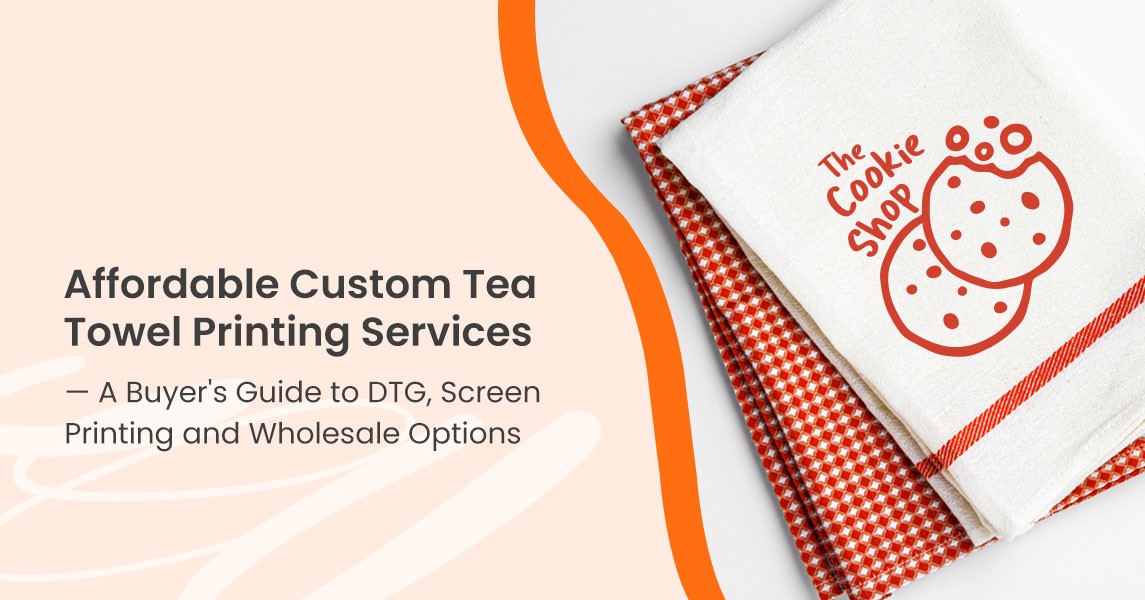
Affordable Custom Tea Towel Printing Services — A Buyer’s Guide to DTG, Screen Printing and Wholesale Options
You want to feel confident you’re getting your money’s worth when buying custom tea towels, and any vendor you choose to provide this service should have straightforward pricing tiers, order minimums and production timelines. You deserve honest answers about which printing method fits your project, what prices are fair and whether you can order a few samples before moving into a larger production run.
This guide breaks down DTG, screen printing and embroidery in plain terms, explains the factors that influence pricing and arms you with the questions to ask before you place an order.
Which Method Should You Choose?
Three techniques for printing on tea towels each have distinct strengths that suit specific scenarios. Selecting correctly from the get-go will save you time and money.
1. DTG Printing
DTG tea towel printing applies ink directly to fabric with no setup screens or minimums. It handles complex, multicolor designs without the color-count charges that come with screen printing, and the ink absorbs into the cotton fiber rather than sitting on the surface.
DTG works best on 100% cotton substrates and makes the most sense when you need design flexibility, want to test samples before committing to volume production or prefer to order custom tea towels without minimums.
2. Screen Printing
Since each color requires a separate screen, this method works best for simple designs with a limited number of colors rather than for complex artwork. Though the ink produces bold, vibrant prints, it also sits on the fabric surface and can crack or fade with washing.
The cost advantage of screen printing over DTG for tea towels typically appears at higher volumes, where you can spread the setup costs across more units.
3. Embroidery
It’s possible to stitch simple logos, monograms or text-based designs directly into fabric to create a raised, textured finish. Embroidery is an excellent choice when you want a tactile, premium feel.
Because the technique relies on stitching rather than printing, it can’t replicate intricate designs or fine detail. Substrate choice also affects what’s possible. For instance, thicker tea towel materials are often better suited to machine embroidery because they can hold up to stitched designs, while lighter-weight fabrics may require extra review before production.
How Much Does Custom Tea Towel Printing Cost?
Custom tea towel printing pricing depends on several factors. When you understand these variables, you can budget accurately and make informed decisions about your project.
Cotton Creations will help you compare your available towel styles, print methods and order quantities to strike a balance between quality and value.
- Towel style: Base pricing varies depending on whether you choose waffle weave, huck or flour sack towels, as material weight and construction quality drive these differences.
- Design complexity: The size of your print area and the number of colors you use determine design costs. You can expect higher prices for multicolor or edge-to-edge printing than for simple single-color graphics.
- Order volume: Setup and production costs get distributed across your entire order, which is why larger quantities mean lower per-unit pricing. For instance, a single towel carries the full weight of those costs, but a 300-unit order spreads them thin.
How to Negotiate Pricing for Wholesale Custom Tea Towels
Wholesale pricing can vary, especially if you place bulk orders. A detailed quote request gives the production team an accurate idea of your quantity, artwork and timing needs, so they can present you with the best available options.
Here’s how to negotiate pricing for wholesale orders.
- Lead with volume and repeat-order potential: Mention your total quantity and whether you anticipate reorders to establish yourself as a high-volume customer.
- Provide complete artwork up front: Submit final designs with your quote request so pricing accounts for actual ink coverage and complexity rather than estimates.
- Share your timeline and flexibility: If you can work around peak season or accept longer lead times, mention them as negotiating points.
- Ask about volume tier breaks: Sometimes, ordering slightly more units will put you into the next pricing tier. Inquire what that threshold is.
The No-Minimum Ordering Advantage
Access to custom kitchen towels with no minimum order requirements matters most when your business model relies on flexibility rather than volume. Because DTG does not require screen setup, ordering a single custom-printed flour sack towel remains practical, while larger quantities may qualify for lower per-unit pricing.
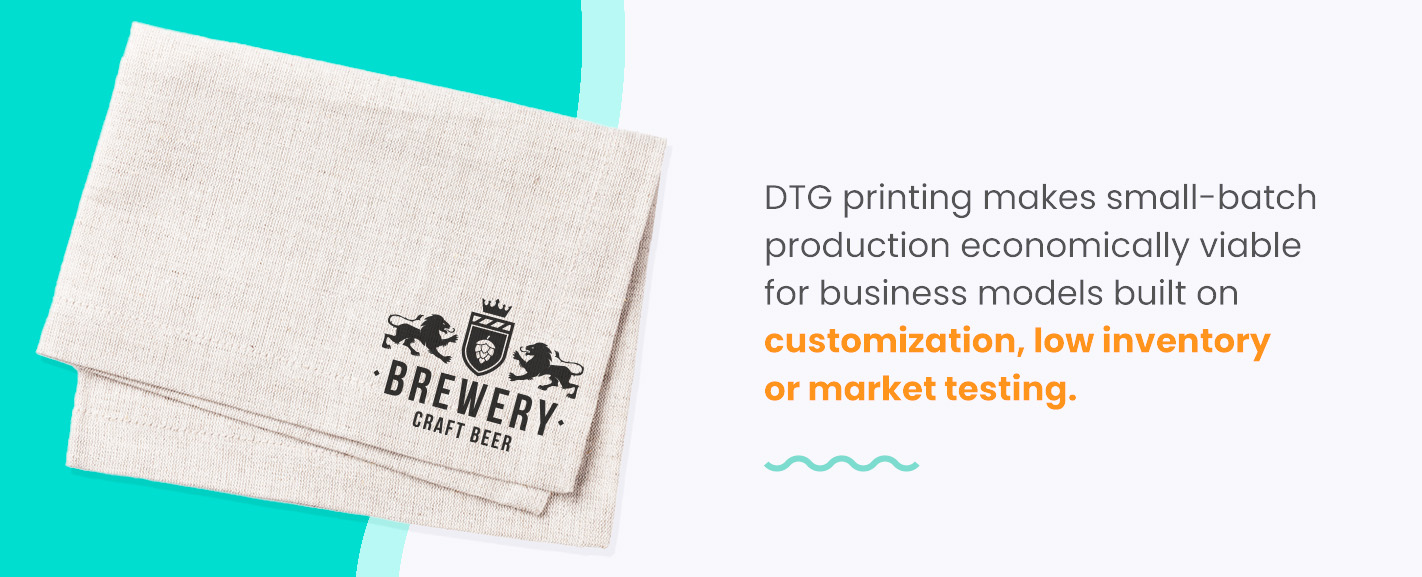
DTG printing makes small-batch production economically viable for business models built on customization, low inventory or market testing. It also makes it easier to test artwork, refresh inventory or personalize towels for smaller campaigns.
What to Know Before You Order
Don’t complete an order until you understand how fabric composition and design complexity determine which printing method you should pick and what your final cost will be.
Fabric Composition
With tea towel printing, fabric composition determines how well the ink bonds and how the print holds up over time. Here’s how each material performs.
- 100% cotton: Generally a decent substrate for DTG printing because water-based inks absorb into natural fibers, creating vibrant, durable prints that withstand repeated washing.
- Blends: These can work, but may require pre-treatment to ensure the ink bonds properly, which often adds cost and processing time.
- Polyester: This synthetic fabric can be less compatible with DTG printing because it doesn’t absorb water-based inks as well as natural fibers do.
Design Complexity
Design complexity should inform which printing method you choose, not the other way around. If your artwork includes gradients, photographic elements or more than three colors, DTG can often handle it without color-count charges. However, ink coverage and print area can still affect pricing. Simpler designs with solid colors open up more options.
Turnaround Times and Hidden Costs to Watch For
Turnaround times vary based on order size, customization details, seasonality and rush-service availability, so it’s worth confirming timing up front if you’re ordering for an event, retail launch or promotional campaign.
When comparing printers, ask about setup fees, color separation charges, design revision fees and shipping costs, as these can increase the quoted price. Unlike screen printing, DTG does not require separate screens for each color, which can simplify setup costs for small orders.
Find the Best Printing Option for Your Tea Towels
The ideal tea towel printing method depends on your artwork, order size and fabric choice. Whether you’re ordering one sample to test a design or looking for affordable personalized tea towel printing, we can provide project-specific pricing based on your selected towel, artwork and quantity.
Contact us today for inquiries or request a quote for bulk custom tea towel orders.